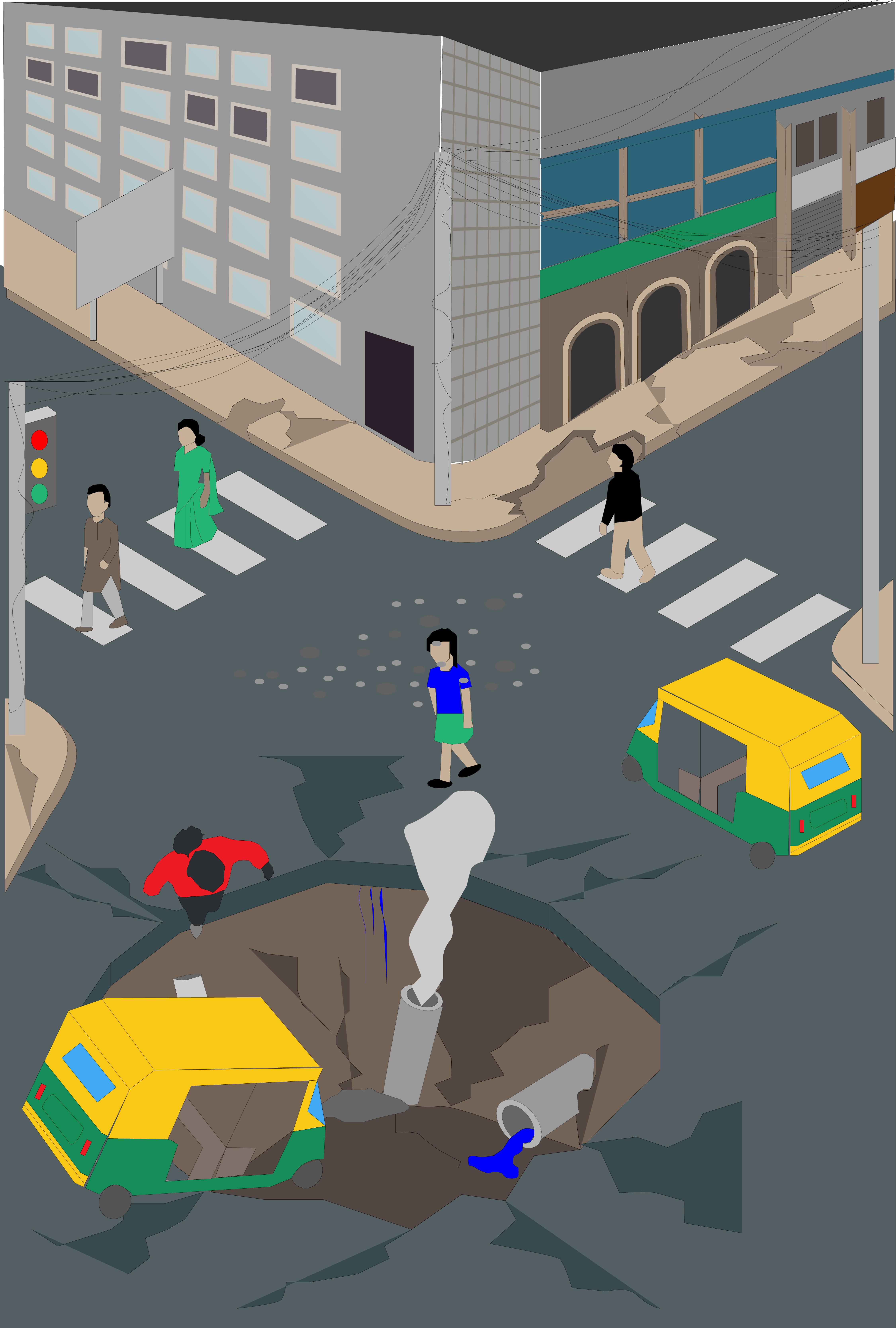

Every city has its monuments.
Some have grand boulevards. Some have public squares. Ours has yellow barricades.
They appear overnight—when your alarm goes off, you walk outside, a crater has opened that could swallow a mid-sized car.
But look! A bright yellow barricade, impossible to miss, has been erected around it! It screams “ALERT! A problem has been officially acknowledged!” Same for the edge of a broken road, around an open drain, beside a flooded underpass, in front of a construction site that seems to have no beginning or end.
Bright yellow, impossible to miss, they announce that something has been noticed.
Not solved. Not fixed. Not transformed.
Just noticed.
The barricade is the city’s favourite infrastructure. It is quicker than a repair, cheaper than a redesign, and more visible than long-term planning. It signals action without demanding resolution.
Over time, the barricade becomes permanent.
The pothole remains. The footpath never arrives. The drain continues to overflow. But the yellow frame stands proudly around the problem, converting failure into management.
In today’s city, progress is increasingly measured not by the disappearance of problems, but by the visibility of interventions. Success is counted in responses rather than outcomes. A barricade erected today becomes evidence that something was done today.
The yellow barricade is therefore more than painted metal. It is a metaphor for decision-making itself. Temporary fixes become long-term strategies. Emergencies become routines. The city moves from solving problems to containing them.
And so, the yellow barricade waits.
A bright reminder that in many cities, the quickest path to progress is not to build a better future, but to place a barrier around the present.
Illustrations and writing by Shravya Ponnaluri.