
The Perpetually Incomplete City
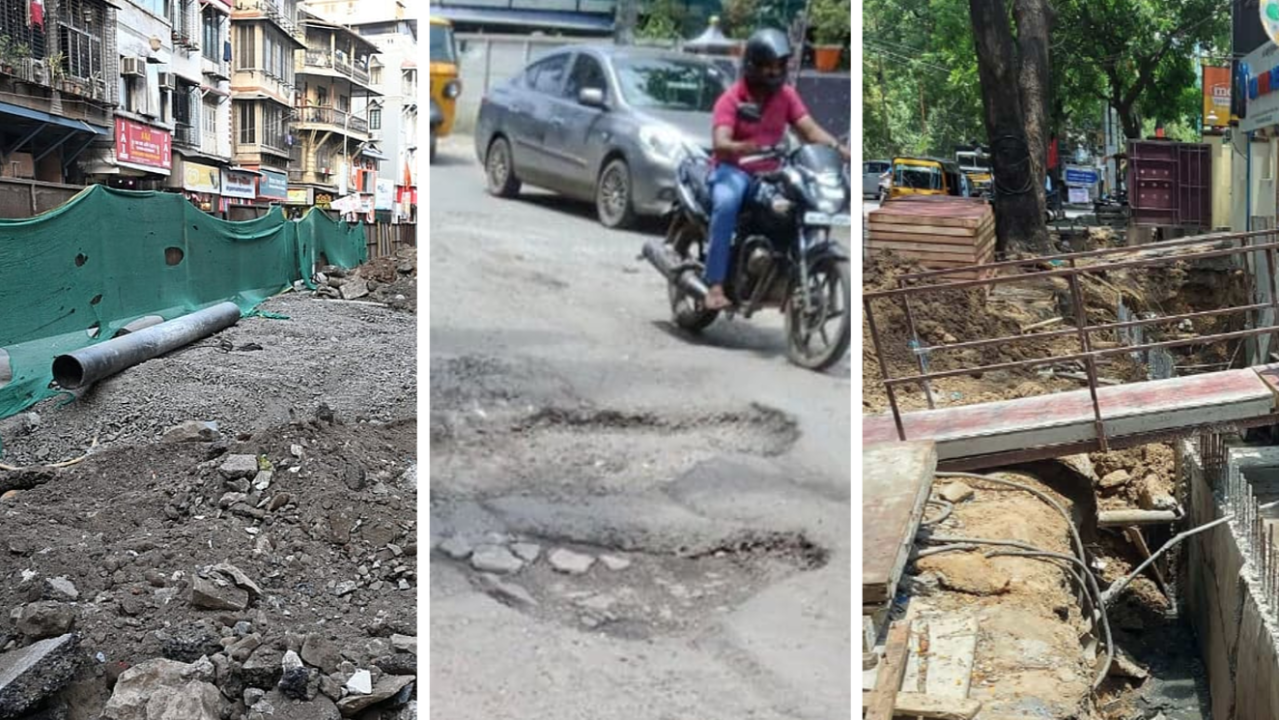
There is a strange sameness to India’s big cities today. Mumbai, Delhi, Chennai, Bengaluru: different histories, climates and economies, but remarkably similar streetscapes — potholes, barricades, trenches, pipes, diversions, half-built flyovers and traffic.
The photographs accompanying this piece could almost be interchanged. Mumbai has hundreds of roads dug up under its ₹17,000-crore concretisation programme; Delhi has roads being dug up, repaired and dug up again; Bengaluru has utility pipes occupying pedestrian space; Chennai has pedestrians negotiating construction sites. The common denominator is not geography. It is the way urban infrastructure is planned, built and governed.
India’s urban population is now about 36% of the country’s total — roughly 500 million people. As cities grow, the question is no longer simply how much infrastructure we can build, but whether we can build and manage it as a system.
The recurring pothole is therefore only the visible symptom. The deeper problem is governance.
We build projects. We don’t build cities.
Our response to urban growth has increasingly been expressed through projects.A flyover to solve congestion. A road widening to solve congestion. A tunnel to solve congestion. An elevated corridor to solve congestion. Then, often, another project to deal with the consequences of the first.
Bengaluru is becoming an unusually instructive case study. The 2.38-km Ejipura flyover was awarded in 2017 for ₹203.2 crore and was supposed to be completed by November 2019. The original contractor achieved only 42.8% progress in more than four years before the contract was terminated. The project was subsequently re-awarded, while land acquisition continued to be resolved. Its estimated cost has now risen to ₹1,761 crore.
Date of Completion: Unknown

The numbers are striking: nearly nine years since work began, more than eight times the original estimated cost, and the project is still being discussed in terms of completion dates.
Then there is the proposed 2.2-km Hebbal short tunnel, estimated at ₹1,240 crore, alongside a ₹403-crore elevated corridor between the UAS staff quarters and Mehkri Circle. The tunnel has generated an unusually useful debate.
An IISc study argues that congestion could simply shift to new bottlenecks around the Veterinary College and Esteem Mall. A separate study commissioned from an IIT Bombay professor argues that the tunnel and flyover could work together and improve traffic flow, while also calling for further traffic studies before finalising the design – but not using independent data.
The important point is not which study wins. It is that the question is being debated at all after the project has already become a major physical and financial proposition.
What are we solving for?
The governance gap
The problem is not that Indian cities lack governments. It is that they have too many governments, and too little governance at the level of the city.
Urban governance is typically spread across three levels. The Union sets programmes, standards and funding frameworks. The State controls much of the legislation, administration and finances governing cities. The Urban Local Body is supposed to be the government closest to citizens. However, a recent NITI Aayog framework, citing CAG audits, notes that urban local bodies across 18 states exercise full jurisdiction over only four of the 18 functions envisaged under the constitutional framework, on average.
Bengaluru recently attempted another major restructuring of its governance. The Greater Bengaluru Authority has replaced the old BBMP framework with five city corporations, in an effort to create a more decentralised and manageable metropolitan administration.
But changing the map of governance does not automatically change the way the city works. The city remains divided among a network of parastatals and agencies: water and sewerage, transport, land-use planning, roads, electricity and major infrastructure sit with different institutions, often with different mandates, budgets and timelines. The road, however, remains one road.
It offers a perfectly logical explanation for how a Bengaluru minister can aggressively implement a footpath-clearance drive, removing the quintessential kattes, while a city agency simultaneously colonises those same footpaths with enormous Hume pipes — for years on end.

There is a democratic gap too. CAG found that 1,600 of 2,625 urban local bodies — 61% — across 17 states did not have an elected council at the time of its audit. PRS Legislative Research. Major cities have not been immune. Bengaluru went without elected municipal representatives after the BBMP council’s term ended in 2020; Mumbai’s elected civic body was similarly absent for almost four years.
The result is an unusual chain of accountability: The Union funds. The State decides. Parastatals build. The municipality manages the aftermath. When responsibility is local but authority is dispersed, the city becomes a collection of projects rather than a coherent whole.
When Infrastructure Becomes the Problem
Bengaluru’s proposed elevated corridors offer a revealing example of how infrastructure can become an end in itself. But before committing public money to such projects, a more fundamental question needs to be asked: what problem are we actually solving, and for whom?
Elevated corridors are presented as solutions to congestion, yet congestion is rarely confined to a single stretch of road. The uncertainty surrounding proposed projects raises another concern. When tenders are floated, planning advances and public resources are committed, only for proposals to be withdrawn or reconsidered, it is a waste of public money. The question is not merely why a project was cancelled. Who approved the tenders floated? Were alternatives examined? Did the proposal emerge from a comprehensive mobility strategy, or from the pressure to demonstrate visible action against congestion?

A cancelled project is not necessarily a failure; withdrawing a proposal that does not stand up to scrutiny can be an act of responsible governance. The failure lies in reaching that point after time, money and institutional effort have already been spent without sufficient clarity about the outcome.
This is the larger problem with project-led urban development. We measure progress by announcements, tenders, construction and expenditure, rather than by whether a project delivers the public benefit it promised. The distinction matters. A flyover is an asset; reduced travel time, safer streets and better access to jobs and services are outcomes. One does not automatically produce the other.
A tender is not a solution. A flyover is not an outcome. And money spent is not proof of progress. Before the next infrastructure proposal is announced, the city must be able to explain not just what it intends to build, but why that intervention is necessary, what alternatives were considered, who will benefit, what consequences it may create, and how its success will be measured – Scientifically! Based on hard data. Not on the whims of a select group. The objective cannot simply be to keep building. It must be to make everyday life in the city work better.
A city without a memory
Perhaps the most revealing feature of Indian urbanism is that the city seems to have very little institutional memory.
Every few years, the problem is rediscovered. A shelved project earns a new life and name. A junction becomes congested. A footpath becomes unusable. A drain floods. A road deteriorates. A corridor becomes too crowded. A new solution is proposed — often with a new consultant, a new tender, a new budget and a new acronym.
Perhaps what our cities need most is not another project, but the ability to finish projects—and finish them well.
Unfinished, poorly executed projects do more than inconvenience citizens; they erode public confidence in the promise of development. A footpath blocked for months, a road dug up soon after resurfacing, a flyover that shifts congestion rather than resolves it—these are not merely construction problems. They are governance failures.
Citizens are not against development. They are against the daily confusion, disruption and uncertainty that pass for it. They are not asking cities to stop changing, but to plan better, coordinate across agencies and deliver what they promise. Progress is not what we build, but how much better it makes everyday life.
Did the flyover solve the congestion? Did the road widening improve movement? Did the footpath become walkable? Did the tunnel address the problem it was commissioned for? And if it didn’t, what did we learn before spending the next ₹1,000 crore?
Until cities can answer these questions, we will continue to confuse activity with progress — and construction with development. The city will keep changing. The question is whether it will ever learn.
– By Nidhi Bhatnagar
References: