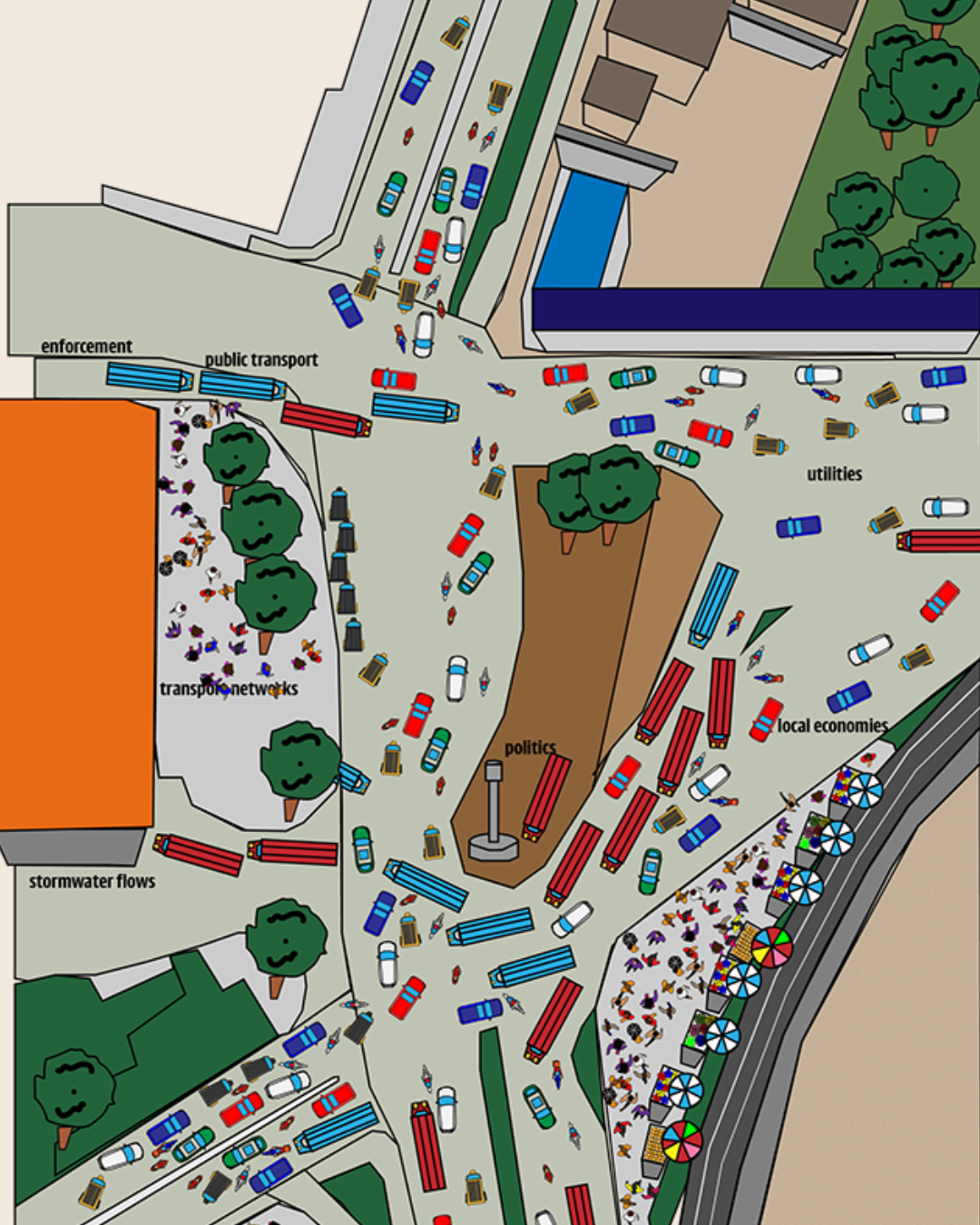

The Anatomy of a Junction
In a certain prominent southern tech-metropolis celebrated for both its booming software exports and its profoundly stationary traffic, there exists a unique playground also known as a junction. To the uninitiated, this intersection is a chaotic soup of daily commuters, market stalls, and sacred spaces. To the enthusiasts of urban governance, however, it is the ultimate monument to the “Spaghetti of Decision-Making.”
As beautiful as the junction has known to be, junctions across the city were never actually designed; they were negotiated into existence. A tea stall morphed into a bus stop; a shortcut became a vibrant market street; a temple created a natural pedestrian crossing. It is a place where a road is never just a road—it is simultaneously an infrastructure asset, a marketplace, a social connector, and a waiting room.
The Bureaucratic Ping-Pong Match
The real comedy begins when formal planning attempts to colonize this organic ecosystem. When a city decides that thousands of daily pedestrian movements and transit trips require an intervention, it sets off a legendary bureaucratic game.
It started with a beautiful dream: a grand pedestrian intervention intended to make crossing a complicated junction safer and more efficient. Plans were drawn up, letters were sent into the bureaucratic ether, and committees began doing what committees do best: meeting.
And meeting.
Months became a year. Approvals were discussed, reconsidered, discussed again, and eventually approved.
But, But, but…approval required money. Which triggered the first major plot twist: THE GRAND BUDGET. It infused the project with a multi-crore chest, but with a catch. The project soon acquired more partners, more responsibilities, and, naturally, more paperwork.
Too many cooks spoil the broth? Not in this case. Three entities, one kitchen, same dish.
Except, somewhere along the way, the recipe changed.
Responsibilities shifted. New agencies entered the picture. The project changed hands, changed shape, and spent stretches of time in quiet contemplation.
At every turn, another meeting appeared, another note was circulated, another layer of approval was added. The proposal grew older; the paperwork grew taller.
And somewhere beneath it all, the original question remained remarkably simple: how do people get across the junction?
Such is the beauty of urban governance. A problem that can be experienced in a few minutes on the street can take years to travel through the system.
The Flyover Fallacy vs. The Elevated Detour
The clash of urban planning philosophies at junctions across the city plays out like a satirical comedy. On one hand, there is the classic, heavy-handed “Flyover Solution.”
Building a massive concrete flyover to solve the problem creates a brand-new comedy of errors. The structure would introduce new conflicts with existing movement patterns, established cultural routes, and the everyday uses that have accumulated around the junction.
The flyover solves one problem— but in doing so, creates several others—a familiar trade-off in urban infrastructure.
Still failing to answer the simple question: how do people get across the junction?
The Eternal City
Ultimately, this metropolis teaches us that good governance does not begin by forcing straight lines onto a curved world. The city contains an intelligence of its own: people adapt routes, occupy edges, share spaces, and continuously reshape how the street functions.
The true challenge of modern planning is not how to wipe the slate clean, but how to look at a tangled mess of overlapping lives. Until then, the files will continue to cycle through committees, the buses will continue to park in the middle of the street for tea breaks, and the citizens will keep gracefully navigating the beautiful, impossible spaghetti.
Written by Shravya Muralidhar Ponnaluri