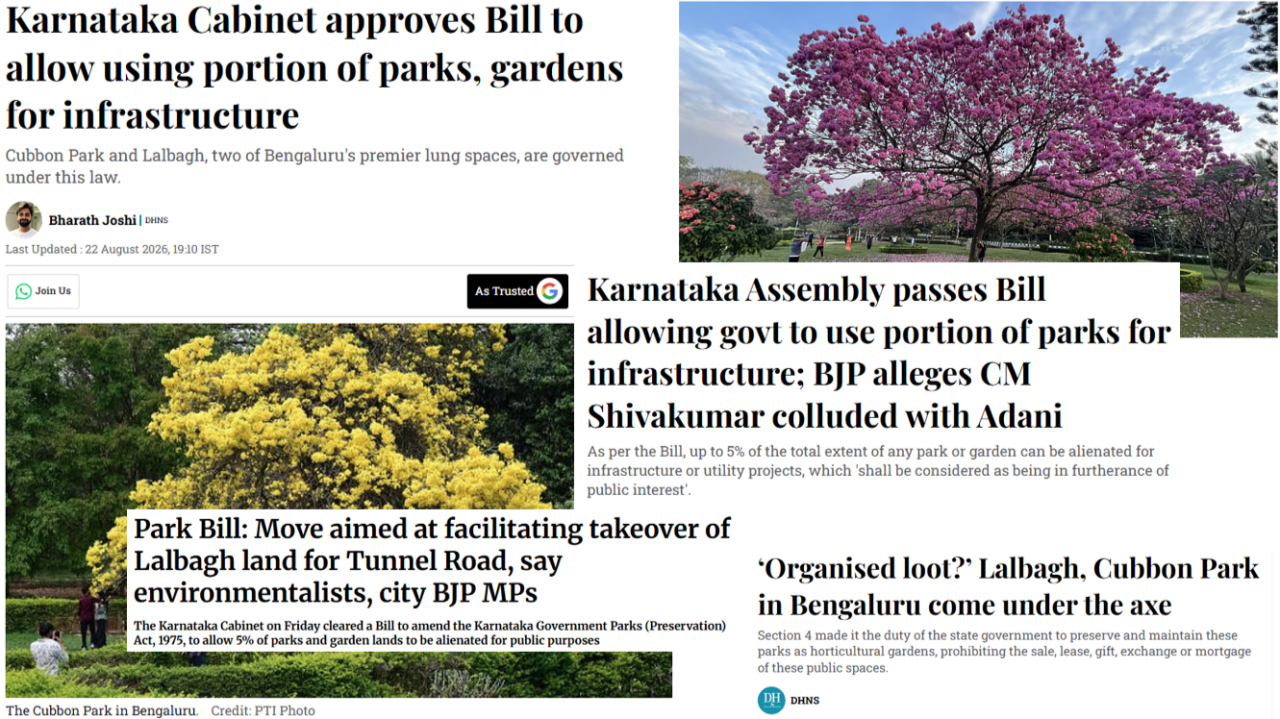

Bengaluru’s latest move to allow portions of government parks and gardens to be used for “public infrastructure and utility projects” should worry anyone concerned about the future of the city. The bill was passed in the Karnataka Assembly without debate, following growing controversy over infrastructure proposals affecting parks and other ecological assets.
The immediate question is simple: what exactly is the infrastructure that requires us to rewrite the rules protecting public green space? This is not an argument against infrastructure. Bengaluru desperately needs it. But it needs to distinguish between infrastructure that makes the city more liveable and infrastructure that simply makes it easier to move through the city.
When Infrastructure Becomes an Excuse
We have seen tunnel roads proposed as a response to congestion. We have seen roads and infrastructure proposals collide with lakes and lake buffers. Each time, citizens protest the loss of ecological and public assets.
And now, rather than stepping back and asking whether the underlying infrastructure strategy is right, we appear to be changing the law to make such projects possible. That is planning backwards.
A park is not vacant land. A lake is not vacant land. A lake buffer is not vacant land. These are already infrastructure — climate infrastructure, public-health infrastructure, recreational infrastructure and social infrastructure – multi-functional. The real question isn’t whether five per cent of a park can be taken. It is: what kind of infrastructure deserves to take it?
A metro station and a tunnel road may both be called infrastructure. But they do not produce the same public value. A pedestrian path, a bus interchange, a sewage treatment facility and an expressway cannot simply be placed in the same category because they are all technically “public infrastructure.”
Who Is the City Being Built For?
This is where the debate becomes political. Infrastructure is never neutral. It distributes benefits and costs. Who saves time because of a tunnel? Who loses a park? Who gains mobility? Who bears the ecological cost? And who gets to decide that one public interest outweighs another? There is an uncomfortable historical echo here.
Colonial Bengaluru was shaped by enclaves of privilege — the Cantonment, clubs, institutional estates and large compounds that created a different kind of city from the old Pete. Land and infrastructure were organised around particular communities, institutions and forms of mobility.
Today, we may be reproducing the logic in a different form: not through colonial compounds, but through infrastructure for privilege.
A tunnel is not inherently elitist. But if enormous public resources are invested in enabling faster private-vehicle movement while citizens continue to struggle with broken footpaths, inadequate buses, unsafe crossings and poor last-mile connectivity, we have to ask whom the city is being designed for.
The problem is not that Bengaluru builds too much. It is that Bengaluru too often builds projects instead of building systems.
The City’s Infrastructure Is Not Just Roads
We need mobility systems, not merely roads. We need water systems, not merely drains. We need public-space networks, not isolated parks. We need climate infrastructure, not post-flood repairs.
The bigger question is therefore not: “Can we legally take five per cent of a park?” It is: “Why does our infrastructure require us to sacrifice infrastructure that already makes the city work?”
Before touching protected public land, every project should have to demonstrate three things: need, alternatives and public value.
What problem is actually being solved? What other modes, alignments and demand-management measures were considered? And does the project generate greater long-term public value than what it destroys?
That is the conversation Bengaluru deserves. Because the danger is not losing five per cent today. The danger is establishing the principle that whenever a project encounters a public or ecological constraint, we can simply change the rules.
A resilient city does not dismantle its natural and public systems to accommodate infrastructure. It designs infrastructure around the systems that keep the city alive. And perhaps that is the bigger question Bengaluru needs to ask: Are we building infrastructure for the city — or building a city around the convenience of those who can afford to move through it fastest?
By Nidhi Bhatnagar