
In Bengaluru—as in many Indian cities—the announcement of a new flyover is still greeted as a sign of progress. It signals action, investment, and intent. It photographs well, satisfies political optics, and promises to “solve traffic.” But we need to ask a more fundamental question: is this really development, or is it a visible response to a deeper planning failure?
Flyovers are not development. They are, more often than not, an admission—of our inability to manage growth, to prioritise people, and to think beyond short-term fixes.
Speed Is Not Progress
At its core, a flyover is designed to move vehicles faster by removing friction. It privileges throughput over place, velocity over value. In doing so, it reduces the city to a system of corridors rather than a network of lived spaces.
But cities are not meant to be optimised only for movement. They are places of exchange—social, economic, and cultural. Streets are not merely conduits; they are the most democratic public spaces we have.
The assumption that faster movement equals development is both flawed and outdated. Around the world, cities that once embraced elevated highways are actively dismantling them. Across the world, cities are not building more flyovers—they are removing them, reclaiming space for the public realm. The difference is not one of capacity, but of intent. We have the opportunity today to learn from these shifts and, more importantly, to preempt the mistakes others are now working hard to undo.
In Seoul, the removal of the Cheonggyecheon Expressway brought back a historic stream and transformed it into a vibrant public corridor. In San Francisco, the Embarcadero Freeway made way for a waterfront boulevard that reconnected the city to its edge. In Paris, stretches of the Seine’s expressways have been turned into pedestrian promenades, prioritising people over vehicles.


These are not cosmetic interventions. They signal a fundamental shift in urban thinking—from moving cars to improving the quality of urban life.
The Cost We Don’t See
Flyovers promise efficiency, but they externalise their costs onto the city. While a fraction of commuters may save a few minutes, the broader urban system pays a much higher price. First, there is induced demand. Increasing road capacity often leads to more vehicles, not less congestion. The relief is temporary; the problem returns, amplified.
Second, flyovers fragment the urban fabric. They slice through neighbourhoods, disconnect local streets, and create physical and psychological barriers. What lies beneath them—often vast stretches of public land—becomes residual space: dark, noisy, and underutilised.
Third, they degrade the quality of the public realm. Pedestrians are pushed aside, crossings become unsafe, and street-level activity declines. Local economies that depend on footfall—small shops, vendors, informal networks—are disrupted. In Bengaluru, this pattern is increasingly visible. Trees are sacrificed, walkability is compromised, and the ground plane—the very space where the city lives—is diminished. We are investing heavily in infrastructure that bypasses the city rather than strengthening it.
Today it is flyovers. Tomorrow it is tunnel roads. Different forms, same idea—move more cars, faster, at any cost. This thinking is now extending underground. The tunnel roads being proposed as the next “solution” for Bengaluru—out of sight, but not out of system. Like flyovers, they are designed to move more cars faster, without addressing the root issue: our growing dependence on private vehicles. They come at enormous financial and environmental cost, while doing little to improve access for the majority of the city. If anything, they risk locking us into an even more car-dependent future—just below ground instead of above it.

When Relief Becomes Redistribution
The recent opening of a new flyover near Silk Board Junction was widely reported as easing one of Bengaluru’s most notorious bottlenecks. For many commuters, travel time did reduce—at least initially. But almost immediately, congestion began to build up downstream near Ragigudda. What was presented as a solution quickly revealed itself to be a familiar pattern: not the resolution of congestion, but its relocation.
This is not an isolated case; it is a systemic outcome of how flyovers function. By accelerating traffic at one node, they push higher volumes of vehicles into the next. Unless the entire network is redesigned—which is rarely the case—these interventions simply shift the burden from one neighbourhood to another. The city does not become less congested; congestion is redistributed.

The danger of such project-based thinking is that success is measured in fragments. A flyover may “work” within its immediate stretch, but cities operate as interconnected systems. Improvements at one point cannot be evaluated in isolation from their impact elsewhere. In this sense, flyovers often create a false sense of progress—delivering localised relief while deepening systemic inefficiencies.
The Silk Board–Ragigudda stretch is a reminder that congestion is not a problem of insufficient road capacity alone. It is a consequence of how we organise movement across the city—where jobs are located, how people access them, and what modes of transport are prioritised. Without addressing these underlying structures, every new flyover risks becoming part of a continuous cycle: build, relieve, shift, repeat.
Rethinking Development
Development, at its simplest, means making things better. The question we must ask is: are we? Flyovers are not development. They are a form of selective investment—catering primarily to cars, and by extension, to a narrow segment of the city. They exclude far more than they include, privileging speed for a few over access for many.
If flyovers are not development, then what is? True development lies in enhancing access, not merely increasing speed. It lies in creating streets that are safe, inclusive, and active—for those who walk, cycle, use public transport, or depend on the city at street level. It lies in investing in high-quality public transport that moves more people using less space.
And it lies in designing neighbourhoods where daily needs are within reach, reducing the need for long, exhausting commutes.
A single dedicated bus lane can move more people than multiple lanes of private vehicles. A well-designed footpath can generate economic activity far beyond its footprint. A shaded, walkable street can improve health, safety, and social cohesion in ways no elevated road ever can.
This is not an argument against infrastructure. It is an argument for the right kind of infrastructure—for public good – one that serves the many, not just the few; one that strengthens the public realm rather than eroding it.

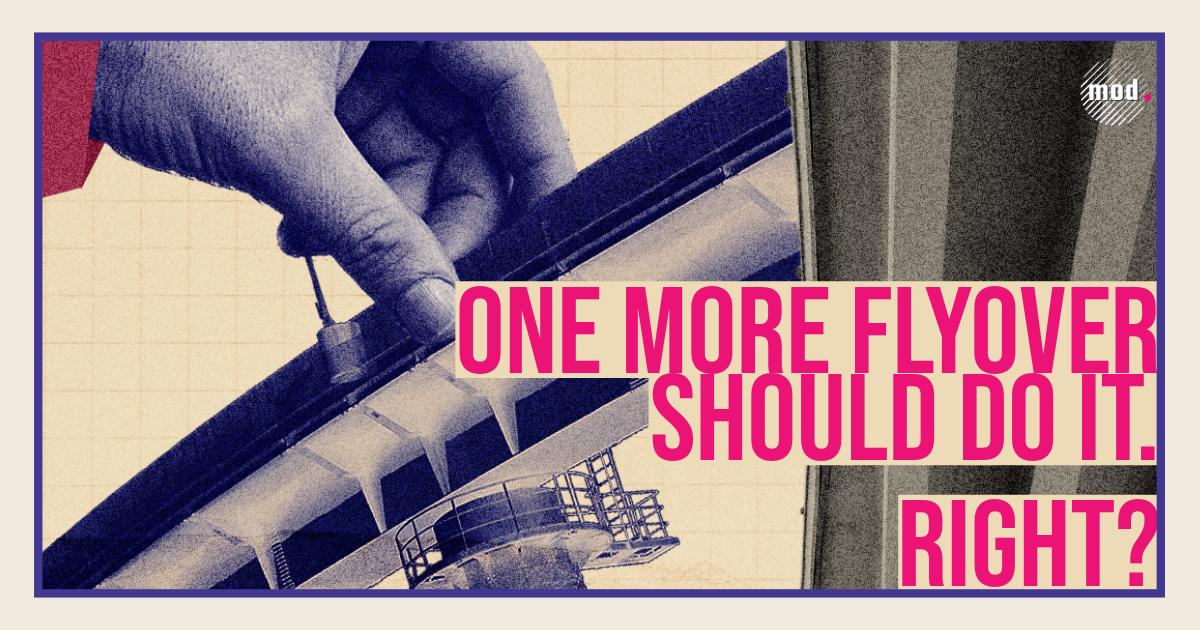
Collage/illustration by Gouri Ammanagi
The Illusion of Progress
Flyovers are seductive because they offer visible, immediate results. But cities are long-term projects. They demand patience, systems thinking, and a commitment to public good over private convenience. If we continue to equate ‘development’ with the movement of vehicles, we will keep building solutions that solve yesterday’s problems while creating tomorrow’s crises.
The real question is simple: are we building cities for movement, or are we building cities for life? Until we answer that honestly, we will keep going in circles—just stuck in more traffic!.
-By Nidhi Bhatnagar
Cover image by Gouri Ammanagi.