
-and What Beautiful Infrastructure Could Mean Today.
There was a time when Bengaluru built beauty into everyday life—quietly, confidently, without needing to announce it or put up a hoarding saying “world-class infrastructure coming soon.”
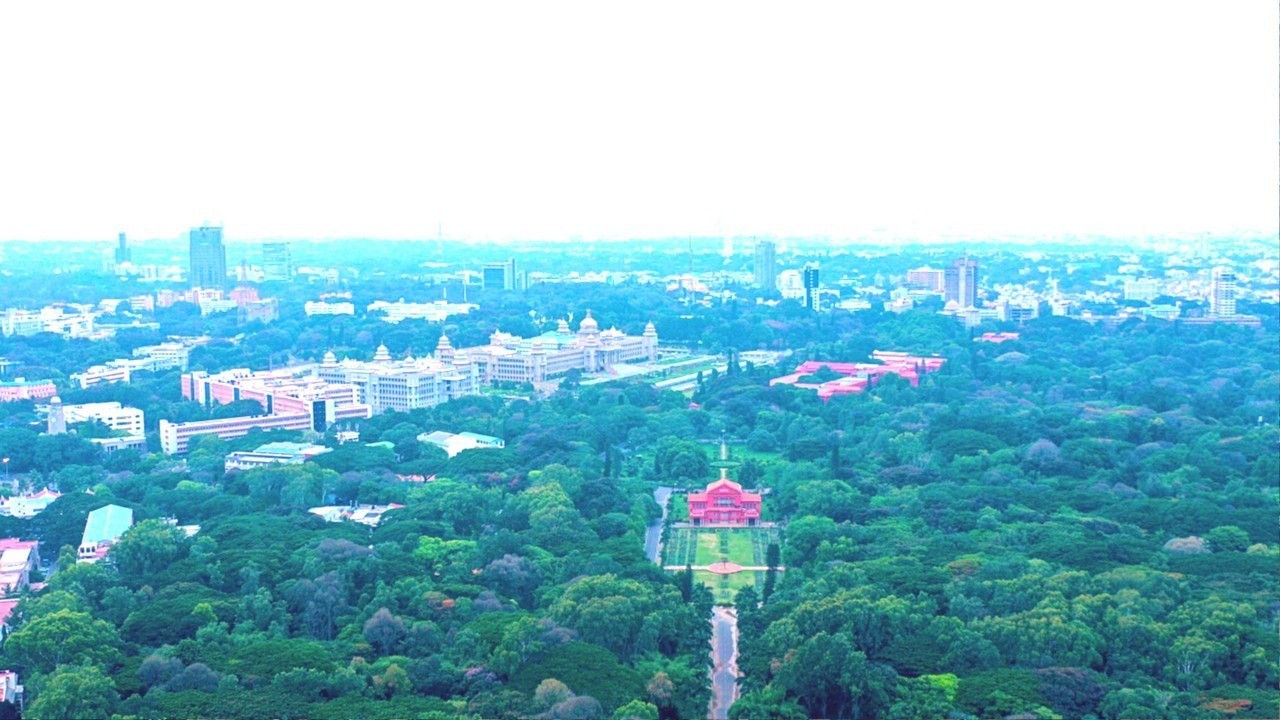
You can still sense it in places like Lalbagh Botanical Garden and Cubbon Park. Not only in the trees or open lawns, but in the details: stone benches worn smooth by decades of use (no QR code required), pathways proportioned for strolling rather than rushing, lamp posts and railings designed to age with dignity. These elements were not ornamental indulgences. They were civic instincts—signals that the city believed everyday spaces mattered.
This is not a sentimental story about congestion, glass towers, or traffic—though Bengaluru has all of those, often at the same junction. It is a story about how we quietly lost the conditions that once made beauty inevitable.

A City That Once Understood Civic Beauty
Bengaluru was an early adopter of modern infrastructure. It was among the first Indian cities to have electrical street lighting—but crucially, this technology arrived with design intelligence. Streetlights were not just utilities bolted onto roads; they were part of a visual and civic language—no temporary wiring, no “adjust maadi” fixes.
Public parks were conceived as democratic spaces, not leftover land. Benches, pathways, and boundary elements were designed with care, proportion, and longevity in mind—built to last more than one monsoon and a change in tender. Materials—stone, cast iron, wood—were chosen not just for cost, but for how they weathered time and touch. Craftsmanship was embedded everywhere. Buildings and public works were assembled slowly, often incrementally, by craftsmen with deep material knowledge. Beauty was not an optional layer applied at the end. It emerged naturally from care, repetition, and continuity.

What Changed Was Not Style, but Systems
The decline of beauty in Bengaluru is often blamed on “modern architecture.” This is misleading. What actually changed was the system that produces the city.
As Bengaluru accelerated—driven by rapid urbanisation, real estate pressures, and economic growth—construction became an exercise in speed, scale, and risk avoidance. Buildings turned into financial instruments. Infrastructure became narrowly technical. Public space was reduced to what remained after engineering requirements were met. Craft was the first casualty. Skilled labour—stone masons, metalworkers, carpenters—found no place in a system optimised for lowest cost and fastest delivery. Design and making split apart. Details were “value engineered” out. Durability gave way to compliance.
The question shifted from Will this last? to Will this clear approvals?
Modern, but Without Character
Today, Bengaluru often describes itself as “modern,” but modernity here is frequently mistaken for neutrality. Buildings aim not to offend, not to age, not to say anything at all—safe design, no comments section. Character is seen as risk. Ornament is dismissed as waste. Permanence is replaced by flexibility, which often just means disposability.
The result is a city that works hard, but feels thin. Glass facades, generic street furniture, and anonymous public works dominate the urban experience. Infrastructure does its job—but rarely builds attachment, pride, or memory. The city moves efficiently, but without resonance—fast, but where exactly?
This mirrors the question – Why Don’t We Build Pretty Things Anymore?: we did not lose the ability to build beautiful things—we dismantled the conditions that made beauty unavoidable.

Infrastructure Without Urbanism
Bengaluru builds projects, not systems.
A road is redesigned without understanding the drain beneath it. A building digs deep without accounting for groundwater movement. A metro station lands without reshaping the street it touches. Each intervention may comply individually. Collectively, they clash.

Historic infrastructure worked differently. Streets, benches, lights, and parks were conceived as part of a continuous civic fabric. They were meant to be lived with, repaired, and inherited. Today’s infrastructure is delivered as isolated solutions, often stripped of context and human scale. Urban failure here is rarely dramatic—it is cumulative.
What Is Beautiful Infrastructure?
Beautiful infrastructure is not decorative excess, and it is not nostalgic imitation.
Beautiful infrastructure is infrastructure that works first—but also acknowledges the human eye, hand, and body.Through this article, we wanted to explore, how beauty once emerged naturally from systems that valued craft, proportion, durability, and repetition, not spectacle. Beautiful infrastructure is legible, tactile, and made to age well. It uses materials honestly, details thoughtfully, and fits its context without shouting for attention. It is not decorative excess, nor nostalgic imitation, but care made visible.
A bench that is comfortable and graceful. A streetlight that is functional and civic. A drain, road, or footpath that does its job while still belonging to the city. When infrastructure is designed as a civic artefact rather than a purely technical object, it builds trust, belonging, and long-term stewardship.
Why Is Public Infrastructure Exempt from Beauty?
This is not to suggest that Bengaluru only produces clinical, characterless buildings. Across the city, private architecture often invests heavily in aesthetics, experience, and identity. The sharper question is this: why does public infrastructure get a free pass from beauty? Sewage treatment plants are reduced to sites of smell. When was the last time any of us woke up thinking today we will go ‘hang‘ at the STP in Bellandur? Garbage segregation facilities are associated only with waste and nuisance. Why aren’t the city’s stormwater drains ever imagined as sites for a glamorous fashion shoot? These are just not ‘cool‘ things to do.

Pipelines run beneath our roads, unseen and unacknowledged. Roads, flyovers, pumping stations, substations, and depots shape the city far more pervasively than any individual building, yet they are designed to be hidden, neutralised, or erased from view. But invisibility breeds ignorance.
When infrastructure is pushed out of sight, we lose any real understanding of how the city functions—and with it, any sense of shared responsibility for the systems that keep Bengaluru running day after day. Out of sight becomes not our problem, until it floods, fails, or collapses—and then suddenly, it’s full scene!! (IYKYK)
Not Nostalgia, but Learning
Rebuilding beauty does not mean copying the past, nor turning Lalbagh into a template or Cubbon Park into a style guide. Cities must evolve, technologies must change, and new needs will always emerge—but progress does not require amnesia. What is worth carrying forward are the values that once shaped Bengaluru’s public realm: care over speed, systems over isolated objects, craft over superficial finish, and the belief that public infrastructure deserves dignity and visibility.
Public infrastructure, powerfully, defines how a city feels and remembers itself. Beauty and utility were never opposites; they worked together. Learning from the past is not about living in it, but about designing a future where efficiency does not erase identity—and where Bengaluru’s everyday infrastructure is once again designed with intention, clarity, and civic pride.
– By Nidhi Bhatnagar